

Introduction
Raising “globally conscious children.” What does that mean, exactly? Well, according to my definition, this article could more accurately be called How to Raise Children to be Open-Minded Citizens Who View the World with Humility and Compassion, Rather Than Ignorant, Self-Centered Nationalists with a Superiority Complex.
Whew. That’s a mouthful. Do you get what I mean?
In my years as a middle- and high-school teacher, I had opportunity to compare the attitudes I saw in my students with what I wanted for my own children. I have worked with some amazing students. But I also recall those who were content in their ignorance, resisting learning about people or places beyond their limited sphere of experience, or worse yet, stubbornly clinging to a misguided disdain of others not like them. Similarly, returning from time overseas, I cringed at some fellow Americans’ insensitive comments about the world or boastful attitudes about our own country.
I long for something different, something better, for my family. As my daughter encounters the world beyond our town, our state, or our country, I want her to be informed, humble, and understanding. I want her to be respectful, gracious, and kind. Perhaps most of all, I want her to reflect well the goodness and love of God wherever she goes.
If these are your desires, as well, keep reading.
Raising Globally Conscious Children: Why This Matters
By nature, humans are self-centered. Babies are only concerned for their immediate physical needs. Young children tend to be selfish, thinking only of the toys they want and not of the children whose toys they took away. Growing into adolescence, middle school students may be extremely sensitive to peer acceptance, yet unthinkingly cruel to those outside their own group of friends. Adults, thankfully, have grown past this…or have we?
Fear, hatred, disrespect, and violence are the easy ways to handle differences, misunderstandings, or just plain ignorance. Unfortunately, the news is full of these. Peace and justice, on the other hand, require us to think beyond ourselves and to value all humans. Whether from a social, political, or spiritual standpoint, it is imperative that we lead our children in learning and caring about others…no matter how distant from our realm of experience, whether in our communities or across the world.
Children who care about others and are knowledgeable about the world will be better prepared to engage in business with other cultures, build and maintain friendships outside of majority culture, and stand up for those being mistreated.
If for no other reason, we need to lead our children in this matter because all peoples of the world were created by God and matter greatly to him! (Read more about this in my husband’s guest post, Which Lives Matter? Recognizing God’s Image.)
What This Series Will Cover
If you have never thought about this before, or if you have long been concerned about issues of social justice, I hope you will find some ideas here to expand your family’s positive interaction with the world at large. If you are not a parent, your influence also counts among those who know and observe you.
This 3-part series will discuss 15 ways we can teach our children to care about people in other places and from different cultures. Some of these suggestions are informational, some are experiential, and some are relational. All of these are worthwhile ways of broadening perspectives, deepening understandings, and raising our children’s (and our own) level of concern for others on our globe.

15 Ways of Raising Globally Conscious Children : A Preview
- Travel with your children
- Talk about your travels
- Explore international cuisine
- Learn (or review) another language together
- Read about people in (or from) other countries
- Listen to world news, not just US-based news
- Know and refer accurately to geography
- Know and refer accurately to people groups
- Teach an accurate view of our own history
- Watch your attitudes, watch your words
- Seek out friends from other countries
- Get involved helping immigrants
- Invest in a foreign ministry run by nationals
- Pray for other countries
- Celebrate God’s view of the world
This first post in the series will focus on the first 5 suggestions listed above. Stay tuned for the second and third installments in coming weeks!
1. Travel with Your Children

People who travel often have a greater appreciation for other cultures, and a greater tolerance for those different from themselves. Travel also gives us a chance to evaluate our own actions and attitudes.
I still remember my first time out of the country.
I was 17 years old when my grandparents invited me to accompany them on a return visit to Kenya, where they had served as missionaries when my mother was a teen. We stayed an entire month, spending time in several areas with people my grandparents had known for nearly 30 years. We were not tourists. We participated in rural church services and frequently ate in Kenyan homes. While most of the time we stayed in a missionary guest house or in modest hotels, we spent at least one night in someone’s home.
Of course, I loved soaking up the typical travel adventures—photographing trees, flowers, giraffes, open markets full of produce, rickety vehicles on pot-hole-riddled roads. But more importantly? What I learned about the world and about myself.
- The moon I saw out my window at night was the same moon my parents could see from home.
- The people—with dark skin, dusty feet, unfamiliar language, and rough accommodations compared to the comfort and cleanliness I was accustomed to—worshiped the same God and read the same Bible my family did back home—perhaps even more earnestly!
- In America, Christians talked about hospitality and strove to practice it. In Kenya, one elderly widow in the desert used some of the last water from her cistern to wash our feet.
- After living happily out of one suitcase of clothes and books for an entire month, while surrounded by poverty, I returned home disgusted by Western consumerism and opulence.
One thing to note: Traveling as a tourist will expose you to a limited portion of the culture—geography, climate, architecture, language, food. But traveling to visit people will reveal how people in that country actually live.
We can hardly wait to take our daughter out of the country to expand her horizons, give her a taste for travel, and deepen her heart for caring about new people.
2. Talk About Your Travels
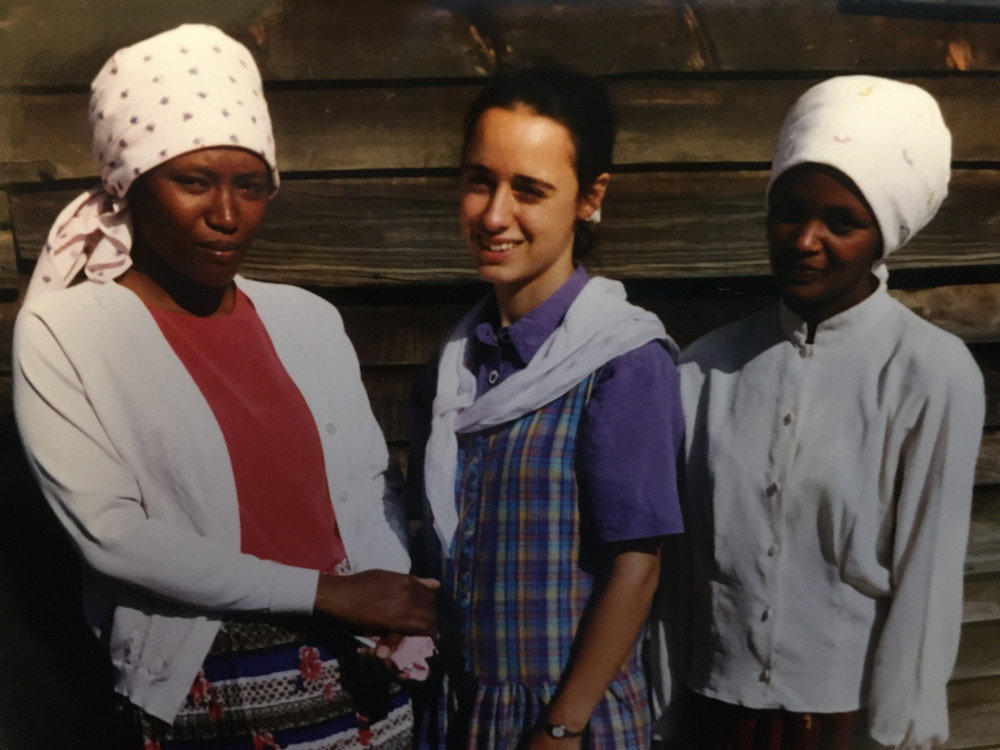
Not every family is able to travel out of the country, whether because of cost, job responsibilities, or even health concerns. (In our situation as a foster family, we would need to find respite care for the foster children and leave them behind, which is not ideal.)
If traveling with your children is not a possibility, the next best thing is to share your pictures, memories, and insights from your travels.
Until we are able to travel internationally as a family, I show my photo albums from Kenya and Kazakhstan to our daughter. I can tell her how Kenyans would sit for hours in a church service or Bible study, and how students in Kazakhstan stood up when the teacher entered the room.
And, occasionally, I cook a favorite dish I learned to love while living or visiting overseas.
3. Explore International Cuisine

Food is only a small part of what makes a culture, but it is something. (We need to see a country or a people group for more than just their food. But it is hard to understand or appreciate a culture or a people without eating their food.)
International flavors build in us a taste for how delicious and delightful different is.
My first memory of non-American food was of a tiny, bare, hole-in-the-wall Indian restaurant my parents drove to for takeout. (This was a big deal, because my family almost NEVER ate at restaurants.) We drove home and spread out the various dishes on our green and orange enameled table. I remember the Indian food was spicy, so my mother served it with yogurt. My parents enjoyed Indian food, so in time, I learned to love it too.
When I was little, my mother went to the city market to buy some kind of starchy root vegetable she had learned to cook from a Puerto Rican family at church. Though I don’t remember the name, I still remember the simple flavor with fondness. From time to time, my mother also cooked up a pot of ugali and greens, a simple Kenyan staple, or made puffed brown pooris on the griddle to go with chicken curry, which she learned from living next to an Indian family in Kenya. These were special times.
This exposure to international foods—along with my family’s culture of continually trying new dishes and discouraging pickiness—developed in me an adventurous palate and a lifelong love of trying new foods, ESPECIALLY ones from other countries.
Developing an Adventurous Palate

consists of horse meat and onions served on a bed of noodles in broth.
Trying new cuisines requires going out of our comfort zones. But if we travel to new places with real people, it is imperative to eat what is set before us to not offend the host. Those who turn up their noses—or worse yet, refuse—something new may not be respected, and may hurt relationships. This may not be an issue for a tourist, but when working or serving in another country for an extended period of time, it is necessary to build trust. Also, in my experience teaching in Central Asia, the Americans happiest and best at building relationships often seemed to be the ones who also enjoyed the local food!
If you or your children are not adventurous eaters, a good place to start is learning to try new dishes within a familiar cuisine. Becoming a more adventurous eater will make travel—and friendships with immigrants in your own country—a lot easier and more pleasant.
Resources and Recipes
For suggestions and recipes, check out the following links.
How to Teach Kids to Love International Food from The Gingered Whisk
Introducing Cultures Through International Cuisines from Globe Trottin’ Kids
101 Kid-Friendly Recipes from Around the World from Bon Voyage with Kids
Food Around the World, an extensive list from BBC
Jale’s Turkish Delights, a blog by my friend about her experiences in Turkey and the recipes she has learned while living there
4. Learn (or Review) Another Language Together

For children, learning a new language may simply be about discovering the fun of learning about the world. But as they grow, it will help them (and us) learn a bit of another culture, and prepares us for communication with others.
Additionally, learning another language helps us identify with and have compassion for the struggles of immigrants or students in our country learning our language.
Though in college I had studied for my certification in teaching English as a Second Language (ESL), living in Kazakhstan for 2 years gave me an entirely new appreciation for the challenges of immigrants.
Learning from Experience
While teaching English in Kazakhstan, I was also studying Russian. My teacher tailored my lessons for the words and phrases I would need for daily living (like shopping and using public transportation). Some larger, western-style grocery stores were available, but more convenient were the many small shops close to our apartment complex. These shops provided ample opportunity to practice Russian, as you had to ask the shopkeeper for the items you wished to purchase. Many of these shopkeepers were friendly and patient with my elementary Russian and I enjoyed the small successes of these interactions.
However, one day I went to a different shop and asked the shopkeeper for a strawberry yogurt. All the cold goods were in a display case behind glass, so I couldn’t just pick it up and pay for it. I used the words I knew to ask for it. She picked up the wrong one. I tried to correct her, and between gestures and repeating the words for strawberry yogurt, got nowhere. She soon grew exasperated and walked away. I returned home without strawberry yogurt, burning with humiliation over my language failure, and even more, at the shopkeeper’s unnecessary rudeness.
From this experience, I now know that the stumbling words and incorrect pronunciations of an English learner do not make that person inept. The mistakes of a language learner probably are coming from a very intelligent adult working hard to learn an unfamiliar language. Now I know to be patient and gracious with an English language learner mispronouncing words, because I know the courage it takes to sound like an idiot in an unfamiliar language.
Not only this, learning a new language will help develop an appreciation for the intelligence inherent in every language that sounds like gibberish to you. And by association, this leads to an appreciation for the people, the speakers of the language.
Language Learning Resources
Duolingo is a free online program, similar to the costly Rosetta Stone. You can choose from up to 36 languages.
Gus on the Go is an inexpensive app great for children, utilizing lots of fun repetition and opportunities to relearn. Gus on the Go is available in 30 languages.
If your purpose is language fluency, there may be better options. But for a not-so-intimidating exposure to a variety of languages, DuoLingo and Gus on the Go offer a fun place to start.
5. Read About People in (or from) Other Countries

and people from other cultures!
Reasoning
Part of learning to read well is learning to analyze perspectives. This means learning to identify what perspective characters (or authors) have about a topic, and considering (from textual clues and/or life experience) why they might hold that view. Outside of reading, analyzing perspectives helps us to understand others—even if we disagree. Analyzing perspectives is important for traveling graciously, as well as for cooperating with others wherever we are.
If you are a white American, chances are that most of the stories you read as a child were about other white Americans or Europeans. (This has been changing in recent years, as educators advocate for all students to be able to read books about people who look like them.)
On the other hand, those of us in majority culture would do well to read books with characters different from us. It’s not just about seeing pictures of people with different skin tones or different types of clothes or houses. It’s about learning what they value, how they think, and how they conduct relationships. It’s about observing how we are the same AND how we are different.
Examples
The children’s picture book that comes immediately to mind is Big Red Lollipop by Rukhsana Khan. In it, a young girl is caught between her Pakistani mother’s values and her American school friends’ expectations. The cultural values were so different than mine that the mother’s sense of fairness and view of ownership felt completely unfair to me. Yet this book provided excellent opportunities to discuss why people may have different values than we hold–and the benefit of those values.
When I was young, my parents subscribed to National Geographic magazine. (Now National Geographic also has children’s magazines and online articles and videos.) At the time I was too young to read the long articles, but I poured over the photographs of people and places from around the world. Fostering an interest in the world outside one’s home starts young.
In my teen years, my parents began receiving a monthly publication from The Voice of the Martyrs, an organization that works to raise awareness of and support persecuted Christians across the globe. Again I was exposed to images of people not like me, from places far away. Amazed at their courage and faith (and challenged in my own), I learned to care about the troubles of others.
To build an interest in and appreciation for other cultures, include in your family’s reading materials texts (and media) that help your children see and learn about people in other places.
Additional Resources
I look forward to checking out the books on these lists:
Read Your Way Around the World with 50 Children’s Books
Children’s Books about Refugees
Part 1 Wrap-Up
Have you been able to travel with your children? What difference has it made in their outlook? What are some fun ways your family tries new foods from other places, or plays with other languages? Do you have favorite books about people from other countries? Or maybe you have questions about the suggestions in this post. I would love to hear from you in the comments section!
Stay tuned for Part 2 and Part 3 of “Raising Globally Conscious Children” in coming weeks!


 Best Anti-Fatigue Mats Under $40
This is such a helpful and insightful post!
I also encourage my children when they question me about our international friends’ cultures and customs, to ask them for their point of view instead of me giving my version of the matter.
Thank you. Laurel. I think that is a wise intention in many situations with children, to ask instead of tell. I always hated when my parents turned a question back on me instead of giving me an answer, but in the long run, it helped to develop my thinking skills.
So well thought out and articulated, Zori; I enjoyed your reflections very much and appreciate the intentionality of the approach you are encouraging from an early age. Especially I enjoyed what you had to say about food; it is so true that this cultivated appreciation builds wonderful bridges. I have often wished more Americans were able to experience other places in ways that would allow them to respect and value others more. I am very grateful for all that is good about our country, but experienced embarrassment in my ignorance of other countries when I would see how much more they are about our country than we about theirs.
Peggy, thank you. I think many of us have experienced that embarrassment in our ignorance at some point in our lives. The important thing, as I see it, is the willingness to learn.